Industries
Manufacturing support for industrial equipment builders.
Ferroline manufactures made-to-drawing components and mechanical assemblies for OEMs, machine builders and engineering teams across industrial markets. Different industries require different materials, component geometries and production processes. Our manufacturing approach starts with the application and technical requirements of each project.
Why the Sector Matters
The drawing defines the part. The industry defines everything around it.
Two components can share a material, a tolerance band and a machining route and still be different jobs. What separates them is where the part is going: whether it will be cleaned every day, whether its provenance has to be documented, whether it is ordered once or ordered again for years. Those constraints arrive before the geometry does, and they decide how a part is finished, inspected and recorded.
Automation
Where the tolerance that matters is the one between parts.
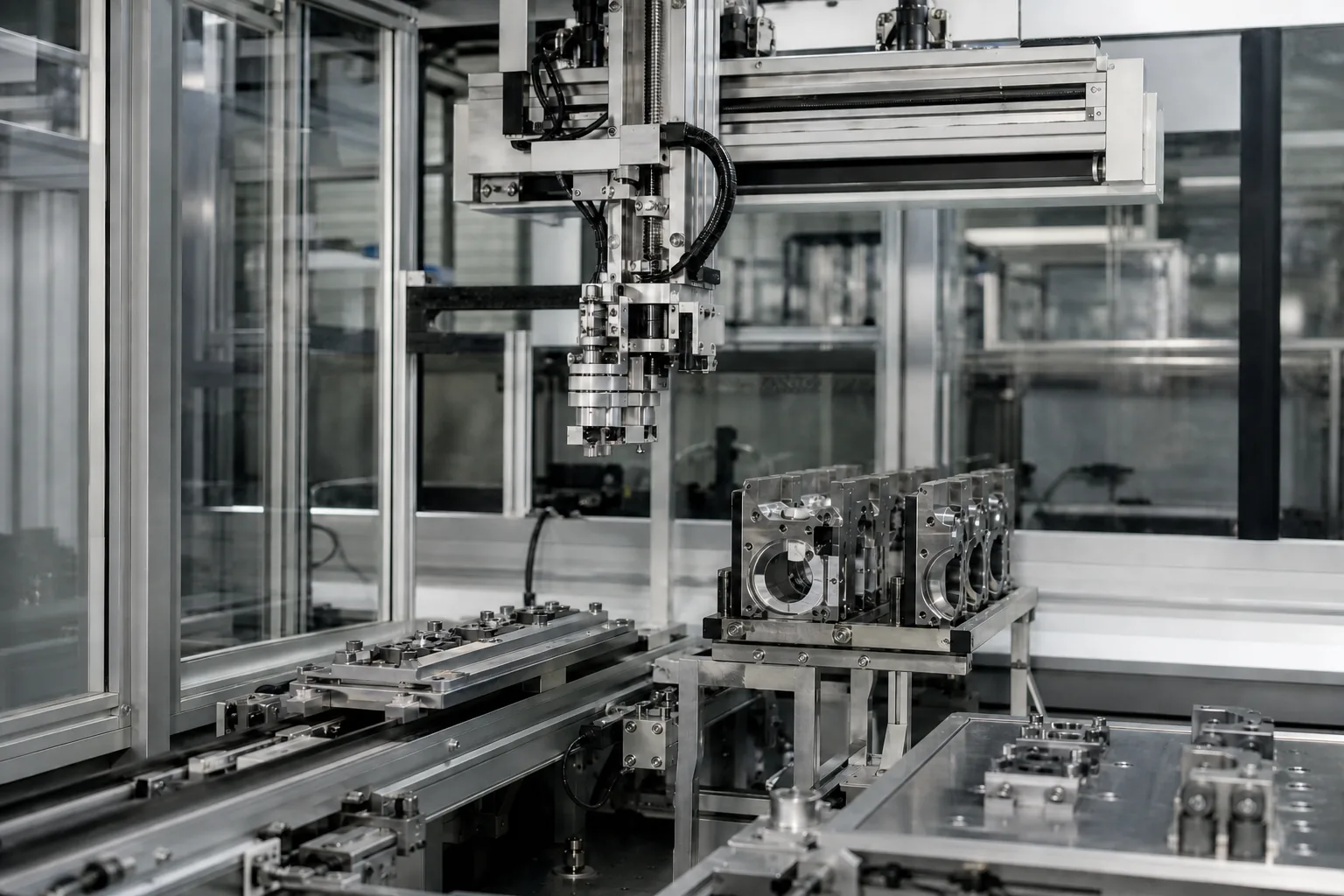
In an automated cell the component is rarely the point. What matters is the interface: where a bracket sets a sensor's line of sight, where a mounting plate fixes a drive relative to a guide, where a shaft diameter decides whether a bearing runs true. The demanding dimensions are the ones that position one part against another, and they are usually not the largest ones on the drawing.
Repeatability is the other half of it. A cell commissioned around the first part expects every later one to sit in the same place, so the useful question is not whether a dimension can be hit but whether it can be held across a batch. Ferroline works from the mounting interfaces outward: the datums that locate the part in the machine are established first, and inspection is aimed at the features the assembly depends on rather than spread evenly across the drawing.
- What the sector demands
- Positional accuracy · Repeatability across a batch · Mounting-interface tolerance · Consistent datums
- Typical parts
- Mounting plates · Precision brackets · Sensor housings · Shafts and rollers · Machine blocks · Mechanical sub-assemblies
Food Processing and Energy
Two sectors where the environment writes the specification.
In both, what the part has to survive matters more than what it has to do.
Food processing
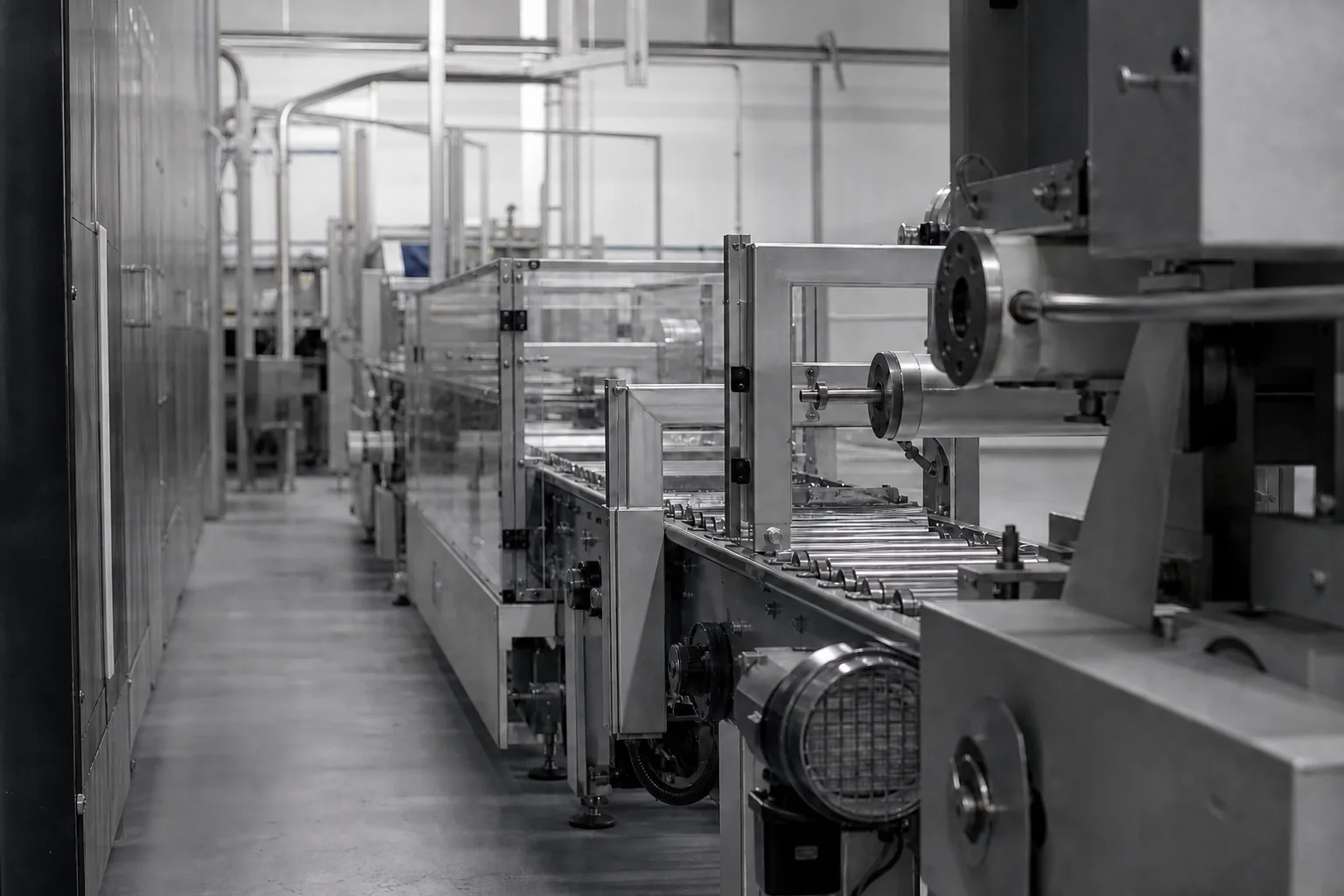
Washdown is the design constraint. Equipment in food production is cleaned on a schedule, with heat, water and chemistry that would be unusual anywhere else. That pushes component design toward stainless steel, toward geometry that drains and can be reached, and away from crevices and blind pockets that cannot be cleaned or inspected. Surface condition stops being cosmetic and becomes part of how the machine is cleaned.
Ferroline manufactures to the material and finish the customer's specification calls for, and where a drawing leaves the surface requirement open on a part destined for a washdown environment, we raise it before production rather than assuming.
Energy
Provenance is the design constraint. Components that retain pressure or carry load in energy equipment usually travel with paperwork: what the material was, where it came from, and what was verified before the part left. The machining itself is often ordinary. The record is not, and a part without its documentation can be as unusable as one made to the wrong size.
Ferroline treats that as part of the job rather than an afterthought: what has to be recorded is agreed from the specification before production, not reconstructed once the part is finished.
Industrial Equipment and Machinery
The same part, ordered two different ways.
These two look alike on a components list and behave differently on a purchase order. A machine builder ordering for a build has a schedule: the part is one line in an assembly that cannot start without it, quantities follow the production plan, and the drawing is current. The same component ordered as a spare arrives with none of that. It is wanted quickly, in ones, long after the machine shipped, and against a drawing revision nobody has looked at since.
Both are ordinary work. They are not the same job, and what makes the second one straightforward is what was recorded during the first. Ferroline keeps the component information established in a production run — drawing revision, material, process route, inspection points — so a repeat order can be manufactured against what was actually made rather than against a fresh reading of the drawing.
- As a build item
- Scheduled against the machine · Ordered in batches · Current drawing revision
- As a spare
- Wanted quickly · Ordered in ones · Against the revision that was built
Your industry isn't listed?
The sectors shown above represent typical industrial applications rather than a limitation of our manufacturing capabilities. Send us the component drawing and project requirements.
- We will review the part based on
- Geometry · Material · Tolerances · Processes · Quantity · Finishing · Assembly · Delivery
Ferroline Components is a fictional company created for demonstration purposes. The industries, applications and customer relationships described on this page are illustrative and do not represent actual clients or delivered projects.